
openELISPOT: Open-Source, Low-Cost ELISpot Reader for Global Research Equity
Empowering labs in low-resource settings to perform high-quality cellular immunity research — without the £30,000 price tag.
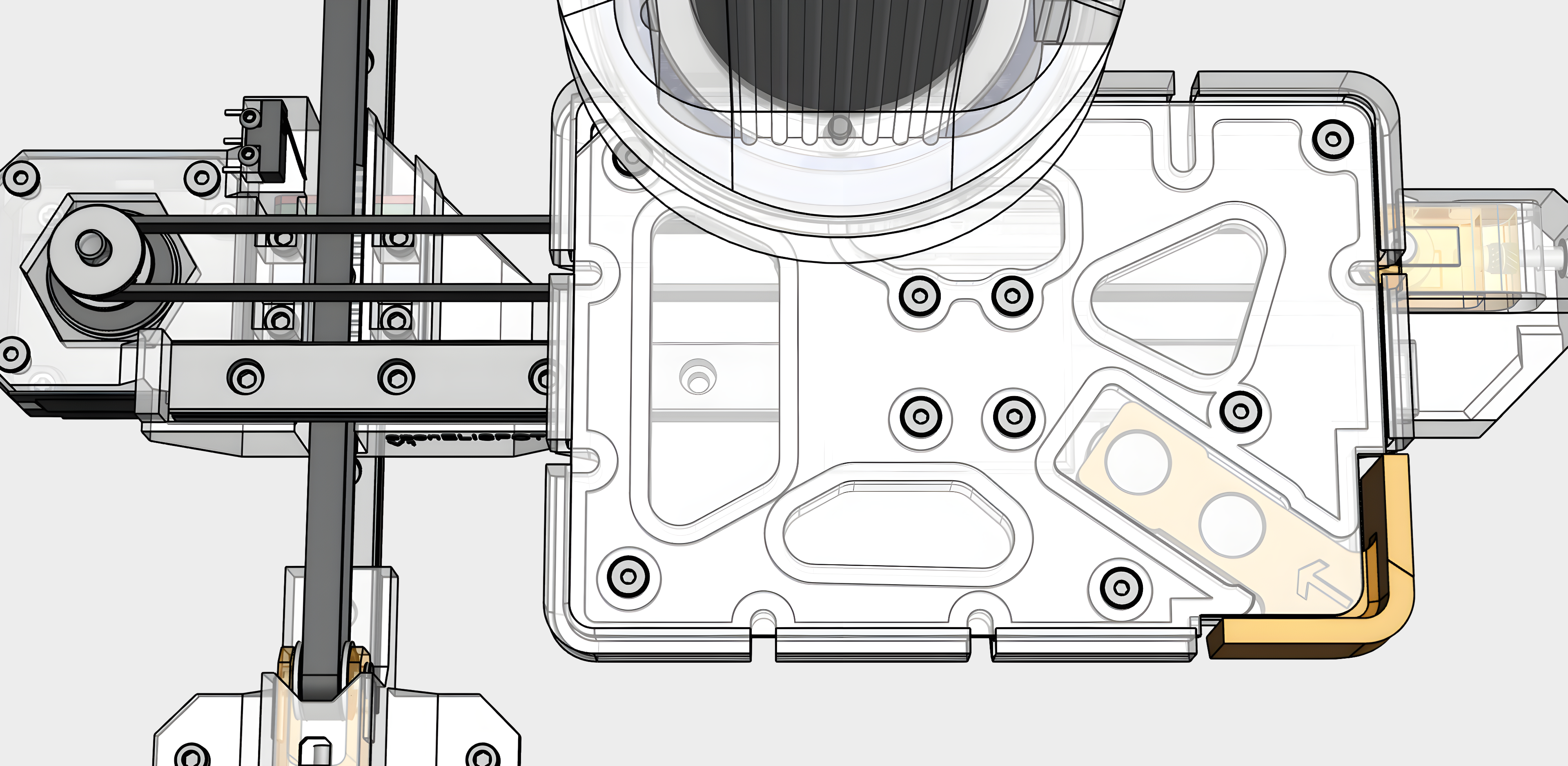
Our mission…
The openELISPOT project is a not-for-profit, open-source initiative led by Dr. Andy Tran and Dr. Mathew John Paul. We’re designing an affordable, fully functional ELISpot reader using 3D printing, off-the-shelf electronics, and open software — so any lab, anywhere, can study T-cell responses to TB, HIV, priority pathogens and cancer.

Low Cost & Accessible
Can be built with off-the-shelf components for under £500, removing financial barriers to cellular immunology research

Locally Manufacturable & Repairable
All custom components are fully 3D-printable with common materials on consumer-grade FDM printers, reducing reliance on proprietary parts

High Performance & Reliability
Delivers spot-count accuracy comparable to commercial readers, reproducible and transparent image analysis for publication-ready data
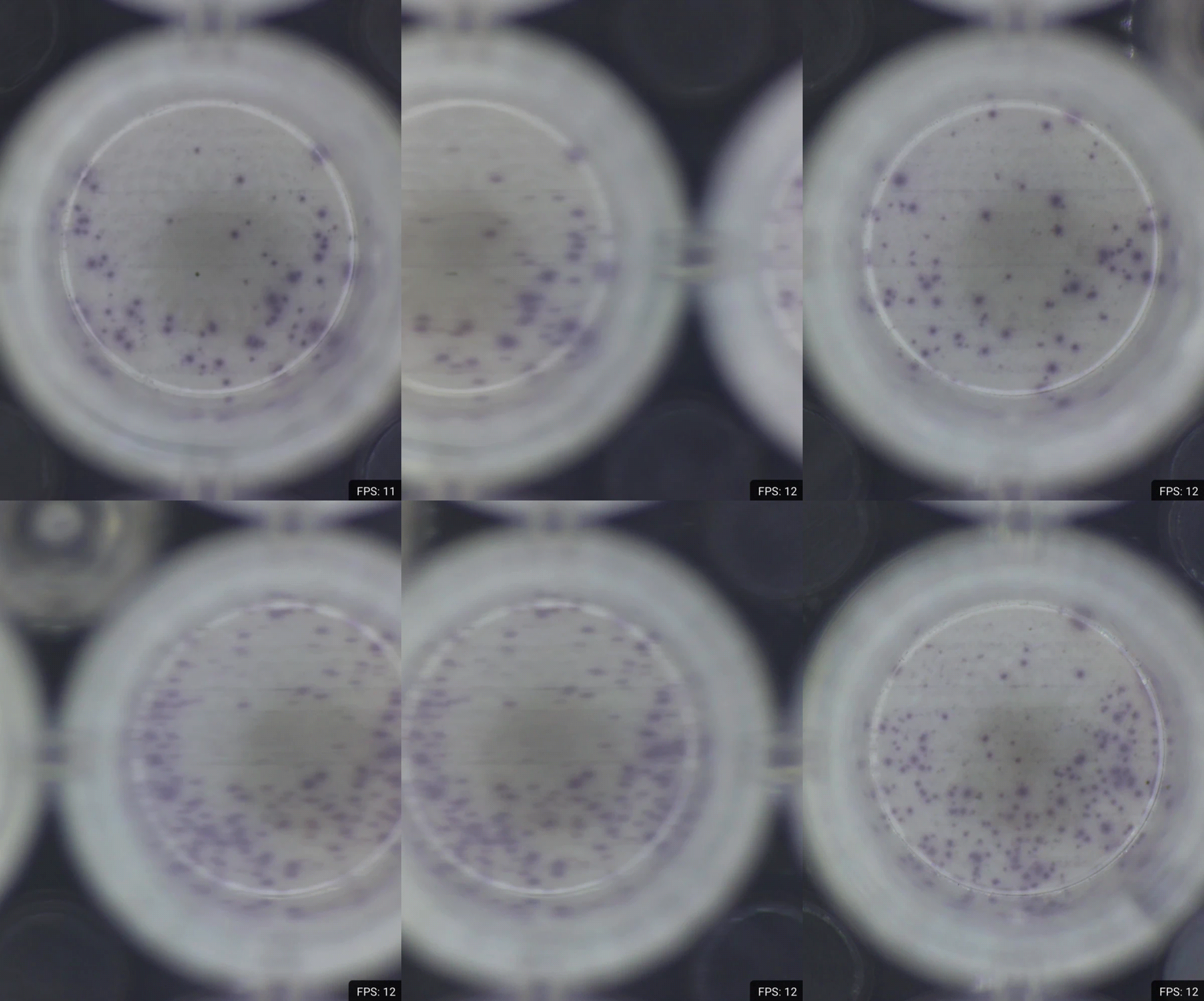
Meet the openELISPOT
Performance you can trust
The openELISPOT reader is designed to deliver highly repeatable and reliable spot counting, comparable to commercially available systems.
- Consistent imaging across 96-well plates
- Optimised illumination and optics for visible ELISpot assays (HRP / ALP)
- Stable mechanical design to minimise motion variability
- Validated through side-by-side testing during the trial phase
This makes the reader suitable for real-world research workflows, teaching labs and demonstrations.
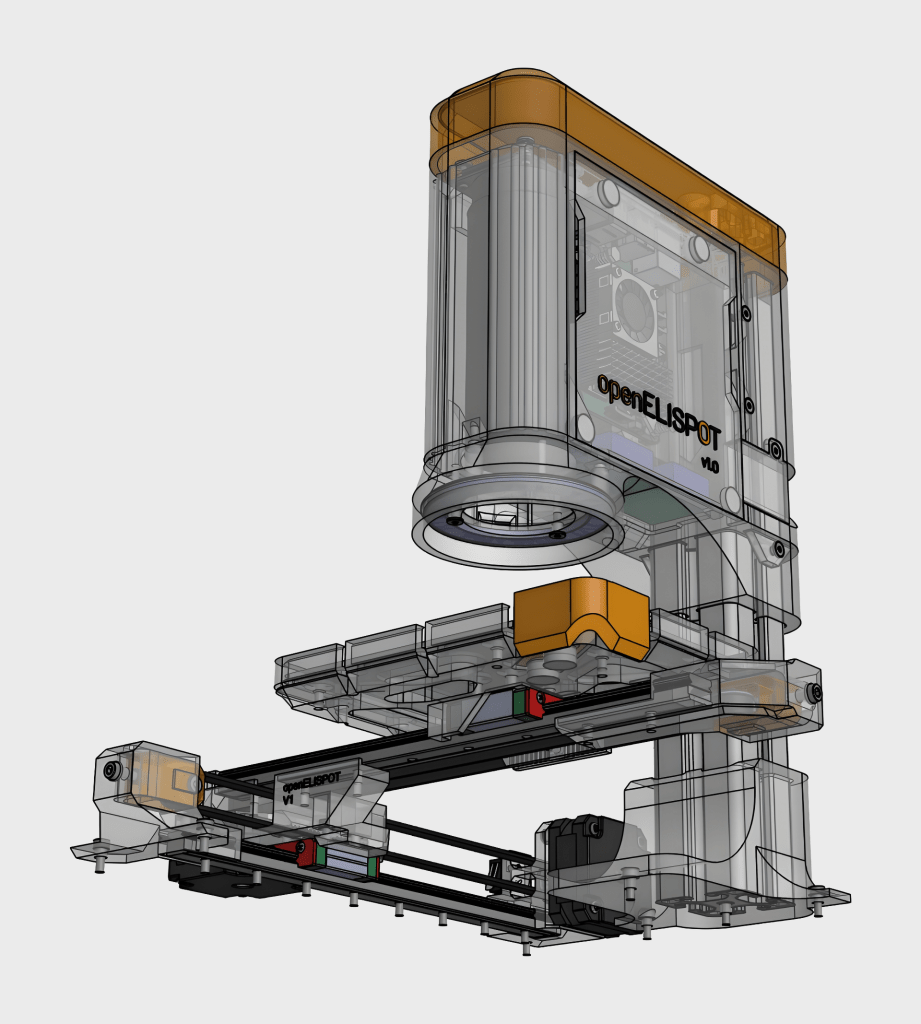
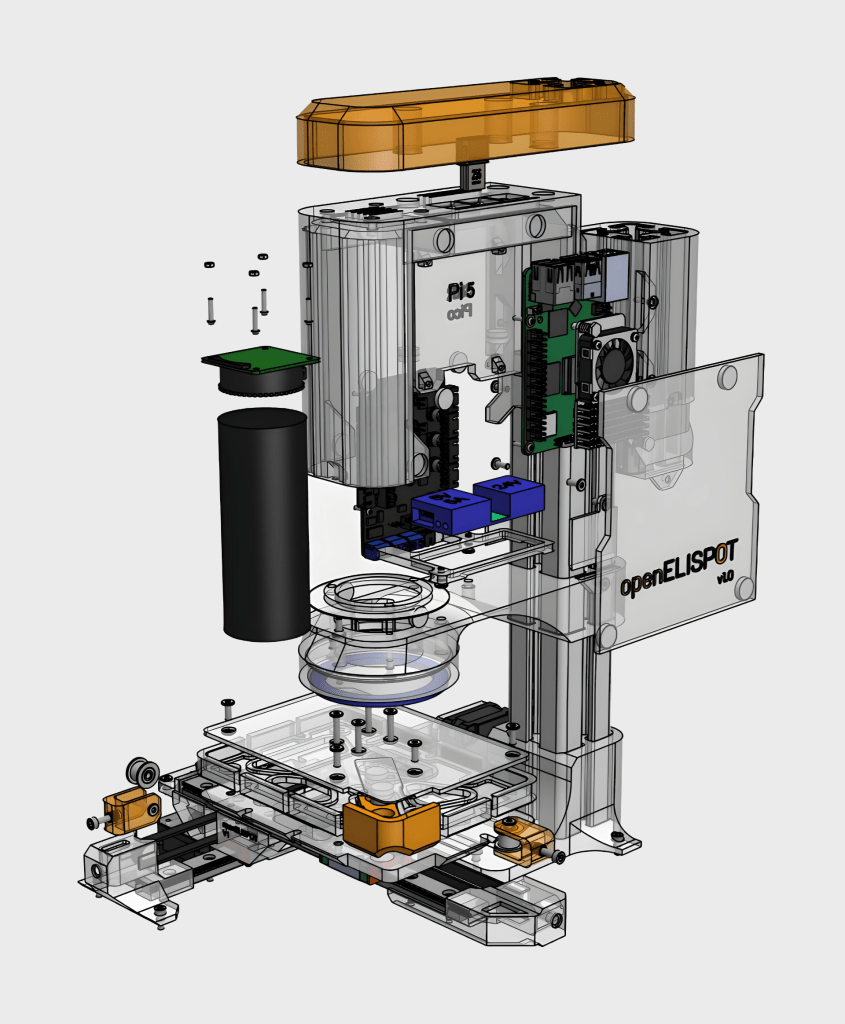
Built for openness and repairability
No costly service contracts, yearly subscriptions, or lengthy repairs. If something breaks, you can fix it locally.
Unlike closed commercial instruments, openELISPOT is built to be understood, repaired, and improved by its users.
- Open hardware and software
- Modular components
- No proprietary consumables
- Easy replacement of motors, electronics, optics, or printed parts
- Upgrade specific components as technology evolves
Designed to be printed
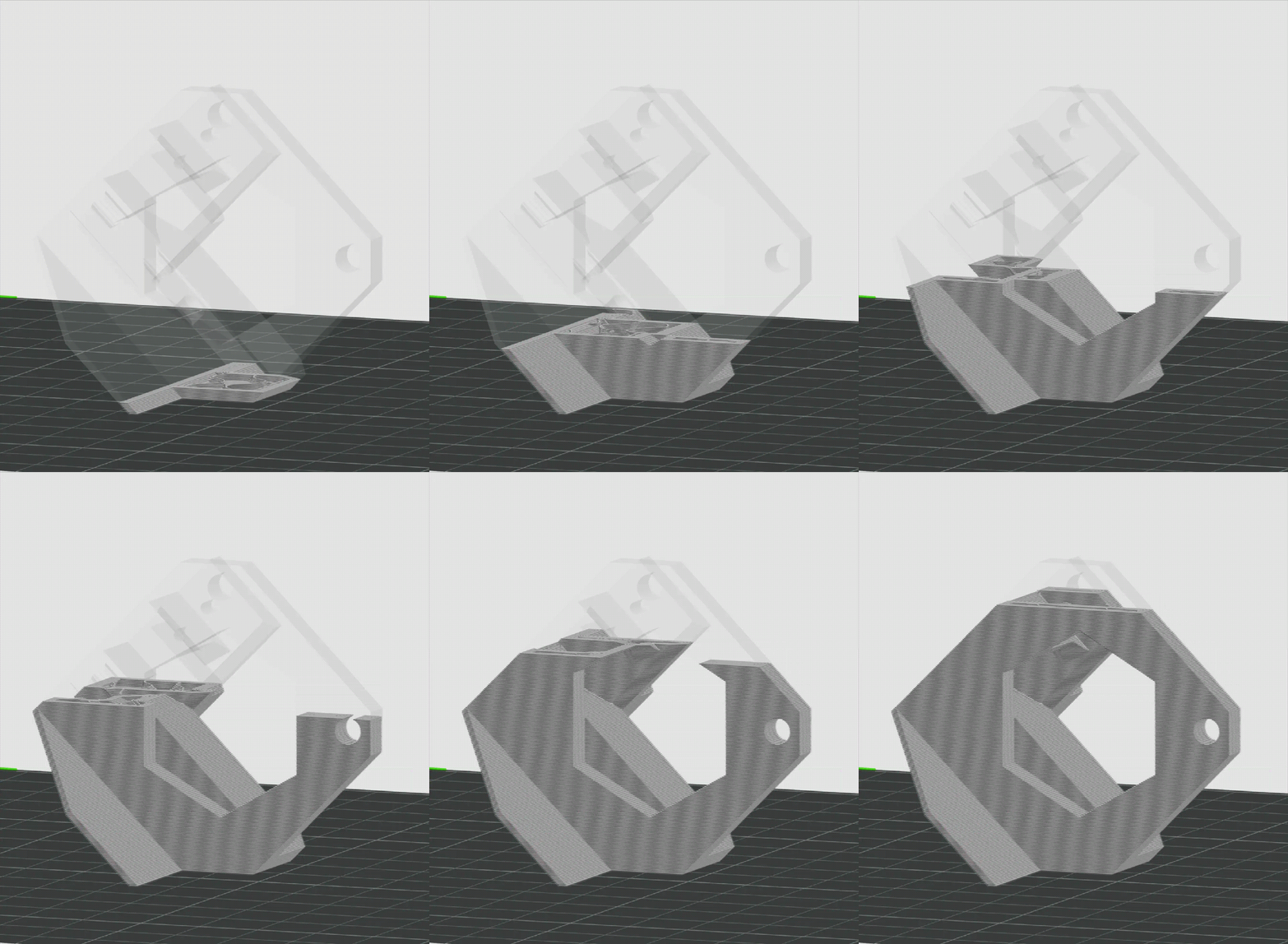
The mechanical design of openELISPOT is optimised specifically for FDM 3D printing, making it increasingly accessible to labs with basic fabrication capabilities.
- Printable using common materials (PETG, ABS, PET-CF etc)
- No slicer supports required
- Engineered specifically for dimensional stability, ensuring warp-free printing even on open-frame printers
- Suitable for local manufacturing and adaptation
Open and customisable software
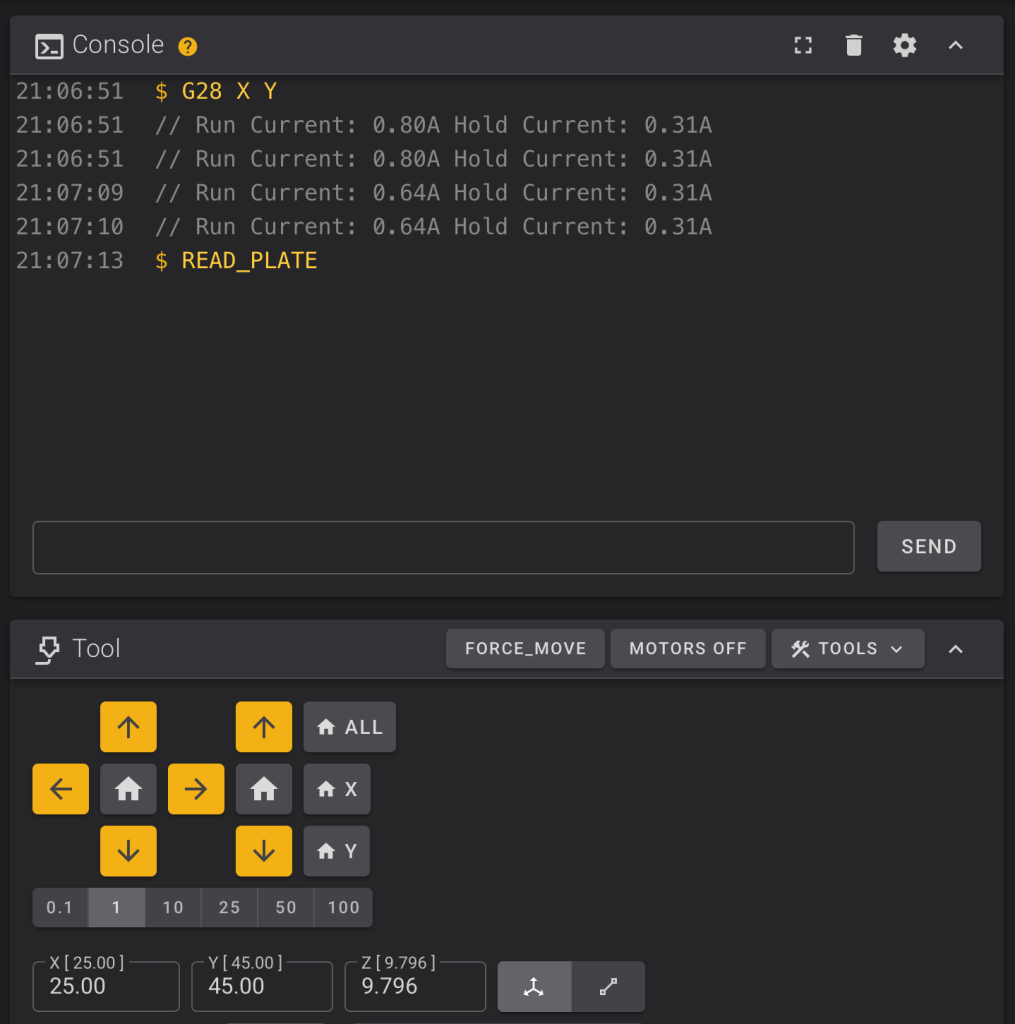
The openELISPOT software stack, based on Raspberry Pi OS, Mainsail, Moonraker, Klipper and OpenCV, is fully open source and designed to be flexible.
- Customisable image acquisition and analysis
- Adaptable for different plate formats
- Transparent image processing pipeline
- Designed to evolve with community input
Users can rely on carefully-designed default workflows, or can modify the software to their specific needs.
Technical Specifications
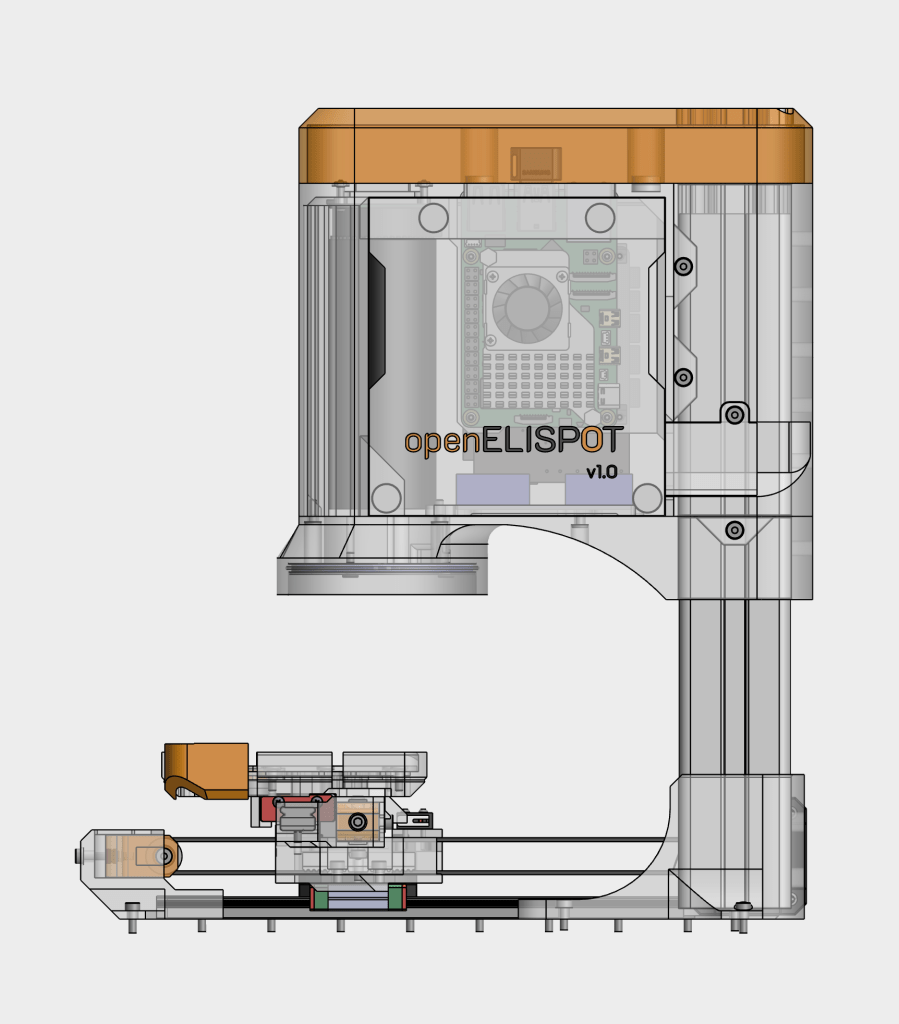
- Dimensions (deployed): 300x300x300mm (WxHxD)
- Weight: TBA
- Plate compatibility: 96 well microplate
- Assay compatibility: Visible stain only, e.g. HRP or ALP (FluoroSpot capability planned for a future release)
- Connectivity: WiFi 2.4GHz WiFi 5 (802.11ac)
- Camera: 12MP BSI Sensor (Sony IMX477)
- Lens: WaveShare 100X Microscope Lens
- SBC: Raspberry Pi 5 (8GB RAM)
- Operating system: Raspberry Pi OS (Debian 12 Bookworm)
- MCU/Mainboard: BigTreeTech SKR Pico V1.0
- Motion system: Cartesian (X+Y)
- Motion repeatability: TBA
- Power: 24V DC in
- Power consumption: <30W
Our Timeline
We are proudly supported by the VALIDATE Network to accelerate the development of openELISPOT through the Directors’ Fund. This project gives us the capacity to build and donate two fully functional openELISPOT prototypes to selected VALIDATE partner labs for testing and optimisation.
Late 2025
openELISPOT reader designed from the ground up, in-house prototype built, tested and finalised. Software configuration and image analysis pipeline complete.
Applications open for VALIDATE members (please note this call has now closed).
Early 2026
VALIDATE Co-Design Collaborators chosen.
Two prototypes shipped to LMIC partner labs for real world testing and feedback.
Optimise and improve design and software for final release.
Mid 2026
Full plans (CAD files, software, assembly guides) released freely on GitHub under CC BY-SA 4.0 License.
2026+
Community builds, kit options, translations and future upgrades (e.g. FluoroSpot) planned.
Build your openELISPOT
We are working hard to develop openELISPOT along with our VALIDATE collaborators, and aim to release full CAD files, assembly guides and software in mid-2026.
Interactive assembly guides will be available on our website, and as a single combined .PDF on GitHub. A complete ground-up build takes approximately two days, and the step-by-step assembly guides will walk you through every stage: from printing parts to wiring electronics, with clear visuals and plain-language instructions.
Meet the Team
Dr. Andy Tran

City St George’s, University of London
Principle investigator, hardware design, CAD, 3D printing
Dr. Matthew Paul

City St George’s, University of London
Project collaborator, software and image analysis pipeline
VALIDATE Co-Design Collaborators
Dr. Thao-Thy Pham

Institute of Tropical Medicine Antwerp, Belgium
Dr Luciana Balboa

Instituto de Investigaciones Biomédicas en Retrovirus y Sida (INBIRS), Argentina
Dr. Kata Horváti

HUN-REN Research Centre for Natural Sciences, Hungary
